Showing posts with label art. Show all posts

Wednesday, 23 September 2009

Here's to Being Spontaneous!

So, after months of being away I've finally been able to paint again, so here's something I threw together. Basically, I tried my hand at something more abstract (I think I had some Pollock on my mind) and this came out.

Bathing Elephant Calf

Bathing Elephant Calf

Acrylic on canvas. The background is a mixture of pthalo blue, ultramarine, cobalt blue, and cerulean blue, with a hint of black. I wanted to get a dark velvety look for the base, and then i splattered it with gold paint. Over that is just a few simple brushstrokes to indicate the elephant. I chose this electric blue simply because, well, I love blue! The squirting water effect was achieved by putting a drip of very watery paint and then blowing so it spreads out (thank you Sanatan for your help with that). Very skilled technique, I know. A few more blue splatters, a bit of white for the eye, and voila! A fun painting completed :D

Enjoy.

Thursday, 26 February 2009

New Painting!

After about a year I finally started painting again. It seems I took a break for a while to work on my drawing and sketching skills, producing artworks on paper using pencils and inks. I decided it was time to get back to paint on canvas and borrowed an easel from my future mother-in-law (who happens to be a wonderful artist!).

I began work on this miniature painting a few weeks ago and took photos of my progress as I went along. This is really fun because I get to see the development of my painting afterwards.

I started by applying a wash of reddish-brown acrylic paint on the canvas, to give the painting a warm undertone. Then I drew a rough outline with paint of what I wanted the painting to look like, as shown below.


After that, I began blocking in the background colours. I find it is best to begin with the background and then work towards the foreground of your painting, that way you give a good amount of attention to the background without dismissing it. I painted the sky, outlined some clouds, made a reflection on the river,and used a toothbrush to spray some paint on the ground to create "sand".


I then started working on the foliage, using blobs of grey-green for leaves. I also developed the sky and sun, using orange, yellow, and red to create a sunset. And I created my horizon on the other side of the river bank.


After I was satisfied with my sky I developed the trees and plants a bit more, and got to work on the under painting of the figures. I used this method of working from "back to front" in order to establish depth. The sky is behind the trees, which are behind the figures, everything is overlapping.


Then I got to work on the details of their faces and skin, paying attention to highlights and shadows to create depth. All the while working to enhance the background as well.


Then I began working on giving depth and detail to their clothes and jewellery, still working on their skin and the background all the time. For the flowers I paint white underneath before adding the pink, this helps the colours pop out from the background.


Finally I added detail to their clothes and jewellery, painted the finishing touches on the flowers and leaves, and signed my name. Here is the completed painting.


Radha-Shyamasundar
by Radhika Bianchi, 2009

Friday, 13 February 2009

Dance as a Form of Worship

Dance is an exquisite art portrayed through music and movement. It is a very involved form of expression which uses the heart, mind, body, and senses; and in the case of Vedic dance- the soul.
In India dance is a way of worshipping God. The dance is treated like an offering to God and the movements are like prayers to please the Lord. There are other dances that are more like dance-dramas, where the actors or dancers re-enact the pastimes and stories of the various gods.

There are several types of traditional dance offerings that come from different parts of India, such as Odissi, Bharatanatyam, Manipuri, Sattriya, Kathak, Kuchipudi, Mohiniattam, and Kathakali.


Odissi

Odissi (oh-di-see) comes from the state of Orissa, in eastern India by the Bay of Bengal. It is a very ancient dance form that was traditionally performed in the temples of Vishnu by the devdasis (women who would spend their entire lives in the temple serving the Lord with devotional dance offerings). There is evidence of the antiquity of Odissi on the ancient temples in Orissa, where many carvings depict the dancers in various traditional Odissi poses.
The costume is unique to other Indian dances in that the jewellery is almost always silver, instead of gold, and the female dancers wear crowns of white flowers in their hair, and the sarees are cotton handloom in the traditional Orissan style. This dance is gorgeously graceful. A good Odissi performance will take the audience's breath away with it's beauty and elegance.
Watch an Odissi performance.

Bharatanatyam

Bharatanatyam (ba-raat-nat-yum) comes from the state of Tamil Nadu in southern India. This dance is characterized by elaborate hand gestures called mudras, fast-pace movement, and stamping of the feet. The costumes are traditionally made of colourful silk sarees with elaborate borders. This dance is performed by both men and women, although women tend to dominate it.
Like Odissi, Bharatanatyam is a dance of devotion and it was originally performed exclusively in the temples as an offering to Vishnu. Over time the dance moved out of the temple halls and into the stages of the wealthy upper class of India.
Watch a Bharatanatyam performance.

Manipuri

Manipuri (maa-nee-poo-ree) comes from the state of Manipur in far east India. Manipuri dance is very sweet and graceful, and because Manipur is so close to China the dance has a hint of oriental style to it. The dancers wear elaborate costumes which are famous for the wide tube-like skirts and white veils. Most of the movement is in the hands and it is graceful like a flowing river.
Manipuri dance usually depicts Krishna and the gopis dancing together in the moonlight. This dance is called the Rasa Leela and is the most popular piece in Manipuri dance theatre.
See Manipuri dancing.

Sattriya

Sattriya is a dance from the state of Assam, in far east India. I don't know much about this dance form, in fact I only heard of it when I started writing this article! But I had to include it because it is one of the 8 classical Indian dances, and after watching a few videos I decided I like it.
Sattriya dancers wear traditional Assamese outfits with colourful prints and designs. The movement of the dance is soft and graceful, with many hand gestures and no stamping. It is a very elegant and gentle form of dance.
Watch a Sattriya performance.

Kathak

Kathak (kaa-tuck) comes from northern India. Kathak dance is different from the other types of dance beacause it has both Hindu and Muslim influences. Some say that the style of dance was a fusion of Indian and Persian culture and this is evident in the costume. Female Kathak dancers generally wear long flowing skirts over trousers and kamis tops, which are typical of Muslim outfits. The style of this dance has a lot of stamping with loud bells on the feet and and many pirouettes and spins. Kathak is especially famous for its spins. The dance is very fast pace and energetic. When the dancers spin their skirts flare out beautifully. A good Kathak dance is quite a spectacle.
Watch a Kathak performance.


Mohiniattam

Mohiniattam (mo-hee-nee-ah-tum) comes from the state of Kerala in south-west India. This dance is traditionally performed by women wearing beautiful white sarees with ornate gold borders. The costume is unique in that the women always wear their hair in a large bun to the side of their head.
Mohiniattam means "dance of the enchantress". It is given this name because the dance is inspired by the goddess Mohini, an avatar of Vishnu, who used her charms to enchant the demons and keep them away from the nectar of immortality. Therefore, the Mohiniattam style is identified by the slow, seductive movement of the hips and upper body, sweet smiling, and coy movements of the eyes.
Watch a Mohiniattam performance.

Kuchipudi

Kuchipudi (koo-chee-pu-dee) comes from the state of Andhra Pradesh in south-east India. The dance costume is very similar to that of Bharatanatyam, and the dancers are usually tall and slender (compared to Odissi dancers). The movements are quick and rounded. Kuchipudi is very unique in that the dancers sometimes dance on brass plates, balancing on the raised edges.
Kuchipudi also has devotional roots and is something of a dance-drama. The dancers perform tales of Shiva, Krishna, etc. with dramatic expressions and movements.
Watch a Kuchipudi performance.

Kathakali

Kathakali (kaa-ta-kaa-lee) also comes from Kerala in south-west India. Kathakali is more of a drama than a dance, but is performed to music and rhythm. The Kathakali costume is very colourful; the actors paint their faces in bright colours, wear large heavy headresses, and huge fluffy dresses. The actors are usually men.
Kathakali performances re-enact stories like the Ramayana, Krishna Leela, and tales of various gods and goddesses.
Watch a Kathakali performance.


There are other types of dance that sprout from India, many having roots from vedic literature.

Apsaras

Apsaras are celestial nymphs who dance in the court Indra, the King of Heaven. They are famous for their talent and extraordinary beauty.
In Cambodia and parts of Indonesia there are women called Apsaras who are trained to dance gracefully and beautifully. They wear gorgeous crowns and slim, body-fitting dresses with gorgeous ornaments and flowers in their hair. This type of dance is very soft and gentle, most of the movement is in the hands. There is absolutely no stamping feet and jumping around, the girls remain poised throughout the dance.
Watch the Apsaras performing.


The Rasa Leela

The Rasa Leela is a dance which was originally performed by Krishna and the beautiful gopis of Vraja about 3000 years BC. This is the most famous dance in all of India and different variations of it are performed by the different schools of dance. Folk dancers generally perform the Rasa Leela using wooden sticks and tapping them together. This is a very sweet and simple dance, and became famous worldwide due to the film Lagaan, which has a Rasa Leela stick dance scene.
Watch the Kuchipudi version of Rasa Leela.


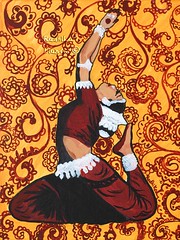
One of my drawings, the painting of the dancer above is also done by me.

Dancer in Vrindavan


*All photos are taken by Sanatan John Howchin.

Monday, 9 February 2009

The Top 8 Must-Have Illustrated Krishna Books

These are the books that inspired me to become an artist and paint Krishna. When I was a child I simply couldn't stop looking at the beautiful illustrations in these books, and I still adore them to this day.


Illuminations from the Bhagavad-Gita

By Kim and Chris Murray. This is a really gorgeous book with full page illustrations by Kim Waters Murray. The paintings are similar to an illuminated manuscript, with wonderful designs and script quoted from the translated Bhagavad Gita by A.C Bhaktivedanta Swami Prabupada. Everytime I look at this book I feel inspired to paint. Recommended for art lovers of all ages.


The Butter Thief

Also by Kim Waters and Chris Murray. This book tells the story of Krishna and his adventures as a little child. This is also really beautifully illustrated with full page paintings of Krishna. It's an incredibly sweet book and was my favourite as a child. This was probably one of the first books I read that inspired me to become an artist. I still have a copy of this book and look at it every now and then to enjoy the nectar of Krishna's pastimes.


Illustrated Bhagavatam Stories: India's Ancient Mystic Culture and Vedic Philosophy (India's Glory & Decline)

Translated by A.C. Bhaktivedanta Swami Prabhupada, retold by Ajamila Das. Illustrated by Jnananjana Dasa(Giampaolo Tomasetti), Sriman Yogendra Rastogi, Sriman Shyamal Kumar Deb, Philip Malpass, Nik Spender, Mark Viney, and Nandarani Devi Dasi. This book was my favourite when I got a little older. The paintings are absolutely fantastic! I used to sit on my bed and look through the pages at the amazing illustrations and wish I could paint as wonderfully as those artists. I still have a copy of this book and I always look at it when I need inspiration. I insist that everyone buy this book! It is an absolute must-have.


Light of the Bhagavata

Written by A.C. Bhaktivedanta Swami Prabhupada and illustrated by Madam Li Yun Sheng
.
This is a beautifully illustrated book with Chinese style paintings. I was really enchanted by this book all my life. The text is really inspiring and the paintings are so beautiful. It's pretty lightweight and not too expensive, so I would recommend anyone who is interested should purchase it.


Hanuman

By Erik Jendresen and Joshua M. Greene. This is a really cool book about Hanuman, the greatest devotee of Lord Rama. Rama is an avatar of Krishna, and this story is just fantastic. This book tells the story of Hanuman and how he helped Rama defeat the demon Ravana and rescue princess Sita. The illustrations are very beautiful. If you don't have it already then click on the link above and get it!


Krishna Art

This is a collection of paintings from ISKCON's BBT archives. With each painting is a page with the story behind the painting, the artist's name, and the year it was completed. This is a huge book containing 400 pages, but it's totally worth it! I'm so depressed I lost my copy of it when I moved to Los Angeles and I never got it back. I used to spend hours and hours looking at each painting and reading the stories. This is the book that inspired me to paint the most. You MUST get this book! It is absolutely the best art book in the world (in my opinion).


Form of Beauty: The Krishna Art of B.G.Sharma

By B.G. Sharma and Swami B.V. Tripurari. This is a compilation of the Krishna paintings of B.G. Sharma. It is really absolutely beautiful, with illustrations done in traditional Rajasthani style. It's not too big and bulky like the Krishna Art book, so it's much easier to have around. I really like this book with its intricate detal and warm, earthy colours. I highly recommend this book for all art lovers (especially traditional Indian art lovers).


Agha, the Terrible Demon: The Childhood Pastimes of Krishna

By Karen Wilson and Joshua Greene. This is a really fun book I used to read often when I was a kid. It tells the story of how Krishna saved his friends from a giant snake demon by using his mystical powers. I loved this book so much. The illustrations are really cute and sweet. It's a wonderful book for children (and adults too if you're like me!)


If you are interested in buying any of the books I have mentioned then please click on the links I have provided, as this helps me to keep my blog going. Thanks!

Sunday, 8 February 2009

A Poem and a Painting

This is a poem I wrote describing Krishna. It is written from the perspective of his mother, Yasoda. Dusk has fallen and Krishna still has not returned from the pastures, so Yasoda becomes anxious and begins to ask of Krishna's whereabouts, describing Him to everyone including the plants and animals.


Krishna

I’m looking for a little boy.
Have you seen him today?
His eyes are bright and filled with joy,
They look just like a summer’s day.

His skin is blackish, tinged with blue,
A monsoon cloud up in the sky.
Soft lips display a reddish hue
And on his bamboo flute they lie.


With peacock feathers in his bun,
And pearls adorn his long black curls.
His smile is brighter than the sun,
It steals the hearts of all the girls.

A garland swings around his neck
With flowers fragrant and sweet.
With gold and jewels he is bedecked,
And tinkling bells around his feet.


His cheeks are pinkish, soft and round
Like roses blooming in the spring.
With lotus eyes so deep and brown
He makes the hearts of Vraja sing.

His face is bright like the full moon,
Framed by earrings that glisten.
When on his flute he plays a tune
Even the birds sit still and listen.


Saturday, 7 February 2009

Music Divine

Today I spent nearly the whole day at the temple, listening to the beautiful bhajans sung by the very talented singers and musicians. I've always appreciated how important music is to me, and to the world. I think music is so moving because it goes beyond this material existence and reaches deeper into our souls. A chord from a musical instrument can make one feel happy, sad, thoughtful, or elated. It seems as if it comes from a higher place. It is said that in the spiritual world every word is a song and every step is a dance.


I always listen to music when I am painting or drawing, it really helps me to focus on what I am doing and set the mood of the picture. Depending on the subject I’ll listen to different kinds of music. For example, if I’m painting something related to India I’ll listen to Indian music (usually classical). If I’m painting a landscape I’ll listen to classical Bach, Mozart, Beethoven, etc. I find that this really helps me to be patient and precise. If I want to get the mood of a painting of Radha and Krishna right I will usually listen to artists like Prem Joshua, Hariprasad Chaurasia, Shiv Kumar Sharma, Karnamrita, Ramya, As Kindred Spirits, Kishori Mohan, and A.C. Bhaktivedanta Swami Prabhupada…to name a few.

Prem Joshua is a musician who artfully blends the eastern and western styles of music. For some of his albums he collaborates with another musician names Manish Vyas. I think the two of them work fantastically together, and two of my all-time favourite albums they have produced together are Water Down the Ganges and Sky Kisses Earth. I never ever get tired of listening to the music on these two albums, and I often listen to them when I am drawing Radha and Krishna. Something about this music gives me so much inspiration that I can honestly say that I have fallen in love with it.

Hariprasad Chaurasia is a renowned musician whose primary instrument is the bamboo flute. He is such an expert flute player. His music is incredibly beautiful and well composed, I listen to it every time I’m painting Krishna and pretend that the sound of the flute is coming from Krishna Himself. Chaurasia’s music is mostly in raga style, but he also has some creative albums. My favourite album since childhood is Music of the Rivers, which uses the flute and other instruments to tell the story of how the river makes it’s journey from the snowy mountain peaks to the delta into the sea. I swear when I hear this album I can actually visualize the turbulent springs in the mountains, the steady flow of the river in the plains, and the magnificence of it’s arrival to the sea.

Shiv Kumar Sharma is a contemporary of Chaurasia’s and has a very similar style. In fact the two have done many collaborative works together. Sharma’s primary instrument is the santoor, which is a very sweet folk instrument from Kashmir. There is one song of Sharma’s that has completely captivated my heart, called Balled from the album Music of the Mountains. This song is so sweet and beautiful that I never get tired of hearing it.
It reminds me of cool breezes, sparkling rivers, calm lakes filled with lotus flowers, palaces made of marble and gold, gorgeous men and women dressed in silk and singing and dancing in harmony, and blue sunny skies filled with puffy white clouds. It basically paints a picture of what heaven might be like, or a time on earth when everything was peaceful and golden, and Krishna walked gracefully through the forests of Vrindavan, enchanting all the creatures along the way.

Karnamrita is a female vocalist who was raised in the west but learned music in India. She has a wonderful album called Dasi: Prayers by Women, that is full of beautiful songs about Radha and Krishna. This is also a bit of an eastern/western blend with instruments like the piano put to Sanskrit verses and traditional Indian songs. The music is very well put together and her voice is pleasant and controlled. I have listened to it often and it really helps me to get into the mood of devotion and love for Radha and Krishna.

Ramya is another female vocalist with a very sweet voice. She has an album called Beloved of Krishna which is full of traditional Vrajabasi (from the land of Vraja) songs and hymns. This album is more folky than Karnamrita’s, but it also beautifully blends eastern and western music with the use of violins and bass guitar. I had an obsession with this album for a while. I found it excellent inspiration for painting Radha because of the folk tunes and rhythms.

As Kindred Spirits is an ensemble of different musicians and instruments that got together to make the album Nectar of Devotion. Now I really had an obsession with this album for a long, long time and I still haven’t completely gotten over it. Here the blend of east-meets-west is much more pronounced and bold. There are songs that sound really traditional and there are others where you can tell the group experimented with different styles (track two sounds a bit Russian at the beginning, but then changes into a gorgeous slow and soft love song). This album explodes with love and devotion for Radha and Krishna. It is so incredibly beautiful and touching it brings tears to my eyes. I heard that the group was coming out with a new album someday soon (their first album came out in 2003 and I’ve been waiting for their next one ever since). I hope so!

Kishori Mohan is a musician who sings in traditional bhajan style. His two albums Cry for Mercy and Hindi Bhajans are simply gorgeous and filled with love for Krishna. My favourite of the two is Hindi Bhajans because it’s a bit more upbeat and full of the folk songs of Vrindavan. It reminds me of Radha and Krishna dancing the the forest, surrounded by the beautiful gopis. I really never tire of it. I’ll often listen to this especially when I want inspiration for a painting of Radha, since tracks two and eight of this album is all about her sweetness and glory. I haven't been able to find the albums for sale online or any links to Kishori Mohan since he's really underground.

A.C. Bhaktivedanta Swami Prabhupada was the founder of the International Society for Krishna Consciousness. In 1965, at the age of 69, he travelled by ship from Bombay to the U.S.A. with the mission to preach love of Krishna in the west. His movement became popular very quickly and spread all over the world. He translated vedic texts like the Bhagavad Gita and Srimad Bhagavatam into many languages. One of the things he stressed was that the best way to get closer to Krishna was by singing and chanting His glories. Prabhupada recorded many songs and albums with devotional prayers about Radha and Krishna. His music is very traditional, using Indian instruments and arranged in bhajan style. Whenever I need to hear what true devotion is, I listen to his albums. Nothing inspires the heart and mind like Srila Prabhupada’s voice.

There are many other musicians that inspire me to paint, and they’re not always Indian or classical. There is a certain instrumental song by John Renbourn called The Trees They Do Grow High from the album Sir John Alot Of Merrie England, which always reminds me of Krishna in the forest.
It’s so beautiful I can listen to it over and over again, and it has brought me to tears on more than one occasion. Maybe it’s the tune of the gorgeous flute, or the soft and steady guitar. Whatever it is, when I listen to that song it’s like my mind gets transported to the flowering groves of Vrindavan and I can actually see Krishna before me.


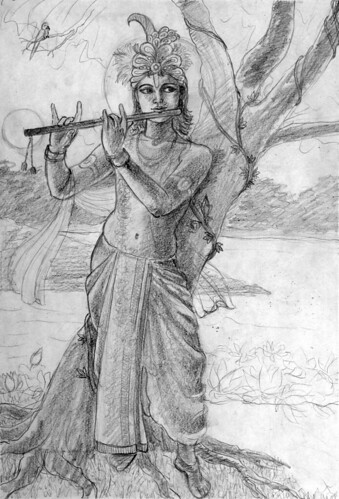
This is a sketch I did of Krishna playing His flute by the banks of the river Yamuna.

Friday, 6 February 2009

Who is Radha?

Srimati Radharani, or Radha as she is more affectionately called, is the ideal woman, and Krishna's most beloved consort. She is loved and revered by many devotees all over the world. In fact, she is so important that whenever people say the names of Radha and Krishna, Radha always comes first. It is said that if one wants to get to Krishna, one must seek the blessings of Radha first.


A Little Bit about Radha's Background

Radha is the Goddess of Fortune. Laxmi, Sita, and all other goddesses are expansions of her. She lived in the beautiful hills of Varshana, in the land of Vraja. Millions go to her temple in Varshana annually to pay her respect. Her father is Vrishabhanu, the king of Varshana, and her mother is Kirtida, the Queen. Radha has a brother named Sridham and a younger sister named Ananga Manjari.

Even though Radha and her family are cowherds they are very wealthy. In vedic times the cow is given much respect, and much wealth in the form of milk, butter, cheese, ghee, and yogurt is traded for silks, gold, and luxurious items. Therefore, though Radha is a milkmaid, she is a princess and wears beautiful silk clothing, precious gems and gold jewellery, and is always decorated with gorgeous flowers, being the sweet country girl that she is.

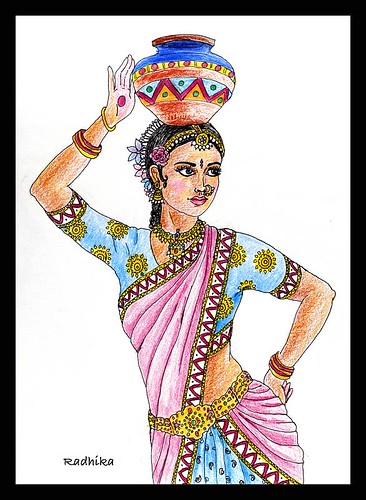
Above is a one of my drawings of Radha balancing a pot of yogurt on her head (as is the tradition with the milkmaids of India) and the pot is decorated with brightly coloured paint. Radha is decorated with bangles, gold earrings, a nosering, a tika (heapiece), a jewelled belt, choker necklace, and beautiful flowers in her hair. Her forehead is decorated with a bindi and her hands are painted with alta (red dye). She is wearing a silk outfit with traditional patterns and prints.

Radha is the foremost of the gopis, and she has 8 main gopi friends who always do whatever they can to ensure that Radha is united with Krishna. These gopis are named Lalita, Vishaka, Champakalata, Indulekha, Chitra Devi, Ranga Devi, Tungavidya, and Sudevi. They all live near Varshana and are very dear to Radha.


Radha's Divine Birth in this World

Radha was born in Varshana or Rawal, just south of Delhi, India. Her birthday is celebrated by millions all over the world and is called Radhastami. This day usually falls sometime in September, but because the vedic calendar follows the moon instead of the sun the date is variable.

As the story goes, when Radha was born she could not open her eyes. When the people of Braja were invited to the celebration of her birth they saw the beautiful golden-complexioned baby girl. Baby Krishna was also brought to the celebration and when he approached Radha she suddenly opened up her eyes and looked at him. Radha refused to open her eyes because the first person she wanted to see was Krishna, and as soon as he was close enough she opened up her gorgeous lotus-like eyes.

Radha's beautiful lotus eyes always recieve much praise. Radha's entire body is incredibly beautiful, and she is perfect in every way. Her skin is like molten gold, her lips are reddish and lush, her hair is thick and silky, her waist is small and her hips are round and perfectly curved. When she walks the sounds of tinkling ankle bells fill the air and her gorgeous hips sway to and fro. She is the epitome of beauty.

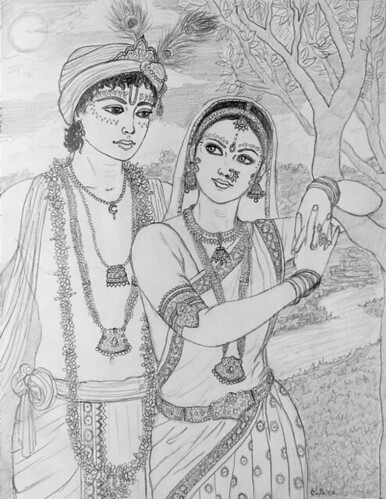
Here is a pencil drawing I have done of Radha and Krishna in the forest. She's being coy :)


The Transcendental Qualities of Srimati Radharani

Radha has many many transcendental qualities, and she has numerous talents. There are 25 top transcendental qualities, some of which are:
  • She is sweetness personified
  • She is always brightly smiling
  • She is expert in the art of singing
  • She is expert in presenting feminine attractions
  • She can speak very nicely and sweetly
  • She is transcendentally cunning
  • She is situated on the highest devotional platform
  • She can give shelter to all kinds of devotees
  • She always keeps Krishna under Her control
Radha can also be quite fiesty and when she has a quarrel or argument with Krishna she becomes fiery and hot-tempered. When Radha becomes angry Krishna becomes appreciative of her gorgeous expressive eyebrows. Even in a bad mood Radha is still incredibly beautiful. These quarrels are part of the nectar of Radha and Krishna's pastimes in Vrindavan.

Radha has many talents, some of which are:
  • She is an incredible cook.
  • She is expert at arranging flowers and making flower garlands.
  • She is a talented musician and singer.
  • She's an amazing dancer.
  • She is clever and quick-witted.
  • And she knows how to please her beloved Krishna.

The Glorious Beauty of Srimati Radharani


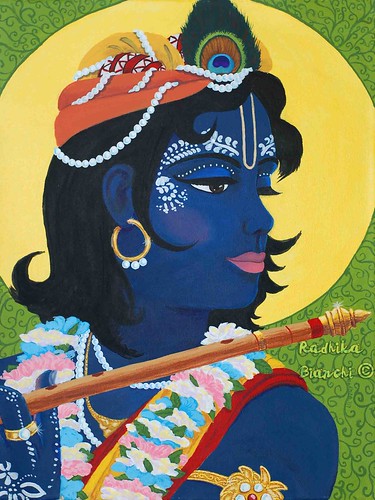
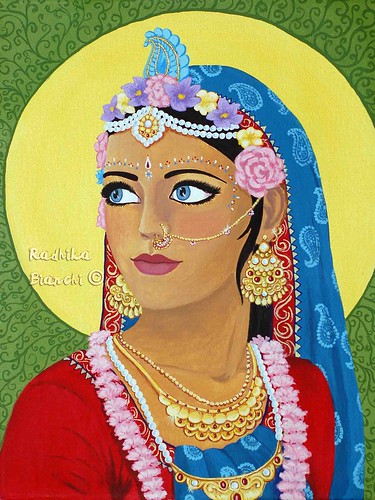
This is a painting of Radha I did using acrylics on canvas. It is part of a set, the other being a painting of Krishna looking towards the right at Radha. I consider this one of my best paintings, and I love Radha so very much.
Some people look up to some celebrity or famous humanitarian for inspiration, and that's fine, but to me Radha is the ultimate idol. No one is better than her.

All glories to Srimati Radharani!

More pictures of Radha


Thursday, 5 February 2009

What Are They Wearing?

Ah, fashion! And how it differs from one culture to another is amazing. One may wonder what this has to do with anything, but let me explain.

The paintings and drawings I show in this blog depict various people wearing what you might call "traditional Indian" or "vedic" clothing. This usually consists of men wearing a dhoti and women wearing sarees.

Most paintings and sculptures of Krishna that I have seen show Him wearing a dhoti. This is a long single piece of material that is artfully wrapped around to make a kind of "trouser". This vedic outfit still survives in India to this day and is worn by many men as an everyday item. For special occasions men might wear a silk dhoti or a dhoti with a very ornate border. ( How to wear a dhoti. )

An interesting side note: the simple, traditional, vedic dhoti is also shown in ancient Egyptian art! The Egyptians seem to have worn a shorter version of the dhoti, what Indians might call a lungi. Here is a fresco found in an ancient building depicting a hunting scene, and the Egyptian in the foreground is clearly wearing a lungi. Were the Egyptians part of that wonderful vedic culture? Did they trade with the ancient Indians? I'd like to think so :)

Anyway, getting back on track. Sarees are the most popular dress for Indian women. A saree is a very long piece of cloth that wraps around the body in a most beautiful way. It's a long thing explaining it but if you're interested you can watch this video on how to put on a saree.
However, Radha is a gopi (cowherd girl) and so she is almost always depicted wearing a skirt and choli with a dupatta. Gopis are milkmaids and wear something I like to call "countryside" couture. This style of dress is very popular in the states of Rajasthan and Gujarat, India. Wheareas sarees were more like "city" gear, usually worn by the upper class. But now nearly every woman in India wears a saree, regardless of caste, status, region, etc.

The type of dress that Radha wears is called a ghagra choli, lehenga, or more simply gopi skirt.


There is some argument about whether in Vedic times women wore cholis, because some say that it is an Arab invention. Many ancient Indian paintings and sculptures depict women wearing a small, single piece of cloth tied around the breasts (what us modern women might call a "boob tube") with a saree or skirt. It is said that Indian women didn't incorporate the choli into their costume until the Muslims invaded, then it sort of seeped into the culture. More recent paintings of Radha show her wearing and choli. Whether all this is true or not, I don't know.


Artist Raja Ravi Varma, 19th century painter from Kerala, India, incorporates both the choli and the "boob tube" in his paintings of women. Although, it seems he only paints the tube on forest women and ascetics, whereas city women and goddesses wear cholis.
To the left is one of Varma's paintings, and you can see that these forest women are not wearing cholis but the more primitive, or shall I say simplistic, alternative.

I especially like Varma's paintings because they are a wonderful blend of east-meets-west. Traditional Indian art tends to be quite stylized, from the voluptuous carvings on the ancient temples to the beautiful paintings of the Mughals and Rajputs.


B.G. Sharma is an artist who's work follows the tradition of Mughal, Kishangarh, and Kangra paintings of old. His paintings of Radha and Krishna are famous worldwide, and he is possibly one of the most renowned artists of his tradition.

His paintings of Radha always have very ornate cholis and skirts decorated with wonderful prints, reminiscent of Mughal textiles. In this painting Krishna is not wearing a dhoti but a very fancy outfit, generally associated with the Rajasthani tradition of dressing Krishna, made up of trousers and a large flowing skirt. This type of outfit incorporates an ornate large headdress that is also typical of this tradition. But until the Muslim invasion of India this style was not invented.

Sharma has a really gorgeous book with his paintings of Radha and Krishna. Form of Beauty: The Krishna Art of B.G.Sharma


Radha Krishna and the Eight Principle Gopis
Murlidhara Das, 1984


This is a famous painting, ( I did not paint this, just to make things clear) which I have loved very much since childhood. The artist has done a wonderful job of displaying the mood of Radha and Krishna, and also the beautiful clothes everyone is wearing. Here you can see the dhoti that Krishna is wearing and the beautiful skirts, cholis, and dupattas donned by the gopi girls.